
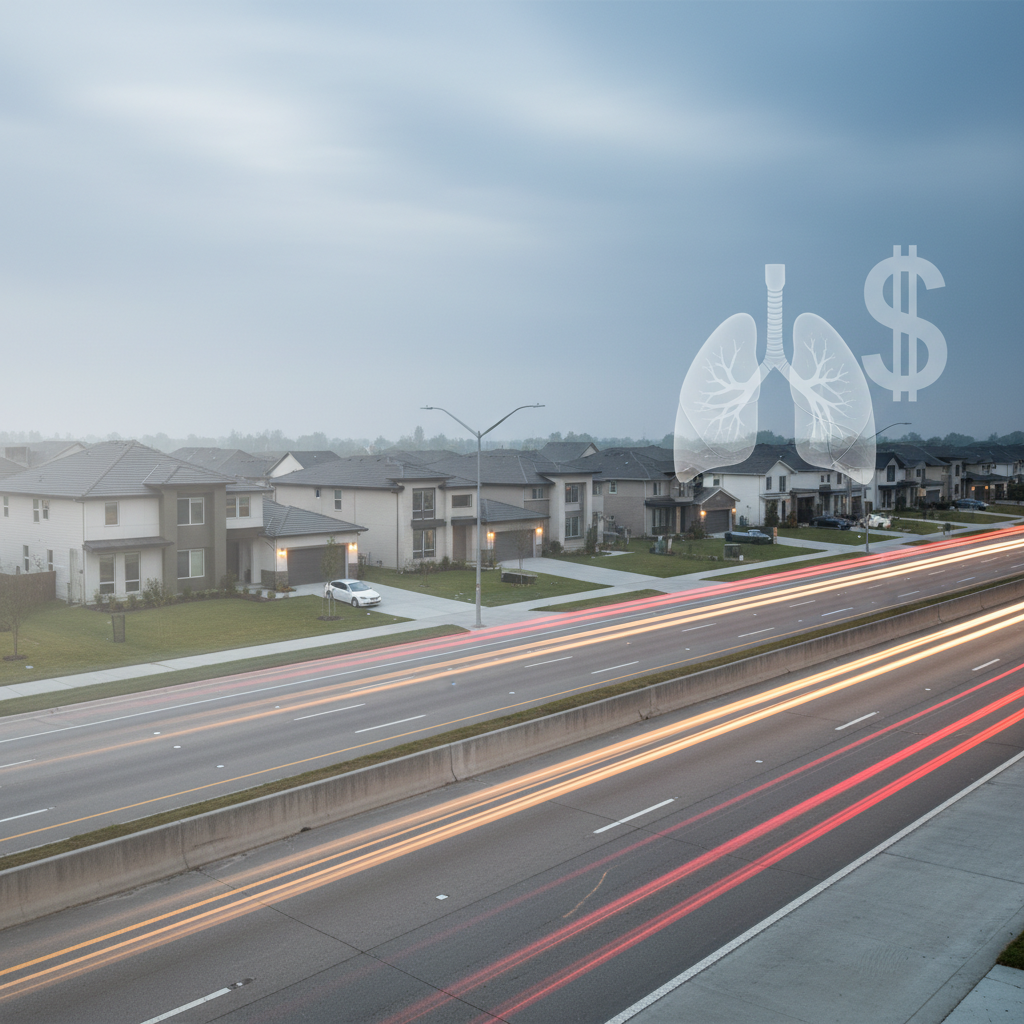
The Hidden Health Costs of Living Too Close to Major Roads: What Real Estate Agents Won't Tell You
A friend of mine just bought a beautiful $485,000 townhouse in Arlington, Virginia, just 200 feet from Interstate 66. The price seemed like a steal compared to similar homes a mile away selling for $550,000. Three months later, her 8-year-old daughter developed persistent asthma, and her own sleep quality plummeted from the constant traffic noise.
She's not alone. Most homebuyers focus on square footage, school districts, and kitchen upgrades while completely overlooking one of the biggest threats to their family's health and long-term finances: proximity to major roadways.
The Real Cost of Traffic Pollution Goes Beyond Gas Prices
Living within 500 feet of a major highway, interstate, or busy arterial road exposes you to significantly higher levels of particulate matter, nitrogen dioxide, and ultrafine particles. The California Air Resources Board found that pollution levels drop by 70% once you get beyond 500 feet from a freeway.
Here's what this means for your wallet:
- Increased asthma medication costs averaging $3,200 annually per affected family member
- Higher health insurance premiums in some states that factor environmental risk
- Reduced home appreciation rates (more on this surprising finding below)
- Sleep disorder treatments ranging from $1,500-$5,000 yearly
Dr. Sarah Chen, a pulmonologist at UCLA Medical Center, treats dozens of patients living near the 405 freeway. "I can often predict where my patients live just by looking at their lung function tests," she told me. "The correlation is that strong."
Why Your Real Estate Agent Stays Quiet About This
Real estate disclosure laws vary wildly by state, but most don't require agents to mention health risks from traffic pollution. In fact, only California requires sellers to disclose if a property sits within certain distances of former military ordnance locations or earthquake fault zones - but nothing about air quality.
I've talked to dozens of agents, and most genuinely don't think about it. They're focused on getting you the best price per square foot, not calculating the lifetime health costs of that "great deal" next to the highway.
One agent in Phoenix admitted, "We show houses near Loop 101 all the time. Buyers love the convenience for commuting. Nobody asks about air quality."
The Surprising Truth About Property Values
Here's where conventional wisdom gets flipped upside down: homes near major roads don't just cost more in health expenses - they also appreciate slower than you'd expect.
A 2019 study by the National Bureau of Economic Research tracked home values near highways in 12 major metropolitan areas over 15 years. Properties within 500 feet of major roadways appreciated 12% slower than comparable homes just 1,000 feet away.
Why? Younger buyers increasingly research air quality before purchasing. Apps like AirVisual and BreezoMeter make it easy to check pollution levels by address. The information that was hidden 20 years ago is now readily available.
Take my friend's Arlington townhouse. Similar units built in 2018 near I-66 have gained 8% in value over five years. Identical units in the same development but farther from the highway? They've jumped 15%.
Smart Ways to Evaluate Traffic Impact Before You Buy
Use the 500-Foot Rule
Measure the distance from the property to the nearest major road carrying more than 10,000 vehicles daily. Google Maps makes this easy - just right-click for distance measurements. Anything under 500 feet should raise red flags.
Check Traffic Counts
Most state DOT websites publish annual traffic count data. In Virginia, you can search by road segment and find exact vehicle counts. Interstate 66 near my friend's house carries 180,000 vehicles daily. That's massive exposure.
Time Your Visits Right
Don't just see the house at 2 PM on a Tuesday. Visit during morning rush hour (7-9 AM) and evening rush hour (5-7 PM). Open the windows. Can you hold a normal conversation? If not, your sleep will suffer.
Research Future Road Projects
Check with local transportation authorities about planned highway expansions or new road construction. A quiet street today might become a major throughway in five years.
When Location Near Roads Makes Sense (Yes, Sometimes It Does)
I'm not saying never buy near busy streets. Sometimes it works:
- You're planning to live there less than five years
- The price discount exceeds $75,000 compared to similar homes
- You or your family members have no history of respiratory issues
- The road has extensive sound barriers and landscaping buffers
Protecting Yourself If You're Already There
Already own a home near a major road? Here are proven ways to reduce health impacts:
- Install a whole-house air filtration system - Expect to spend $2,500-$4,500, but it's cheaper than ongoing medical bills
- Keep windows closed during rush hours - Run air conditioning or fans instead
- Create a buffer with dense vegetation - Plant evergreen trees and shrubs between your home and the road
- Use white noise machines - Better sleep quality reduces stress-related health problems
The Bottom Line for Your Health and Wealth
Real estate agents love to talk about "location, location, location," but they're usually thinking about commute times and shopping centers. Start thinking about air quality and noise pollution as part of location value.
Before you tour your next potential home, spend five minutes researching traffic patterns and measuring distances to major roads. Your lungs and your bank account will thank you in 10 years.
Your next step: If you're currently house hunting, download the AirVisual app and check the air quality index for every property you're considering. Anything consistently above 100 should make you think twice, regardless of the granite countertops.